The mbed Microcontrollers are a series of official mbed prototyping modules based on the mbed HDK. They provide fast, flexible and low-risk and professional rapid prototyping solutions to jump-start your design.
They are packaged in a 40-pin 0.1" DIP form-factor convenient for prototyping with solderless breadboard, stripboard, and through-hole PCBs. They include a built-in USB programming interface that is as simple as using a USB Flash Drive. Plug it in, drop on an ARM program binary, and its up and running!
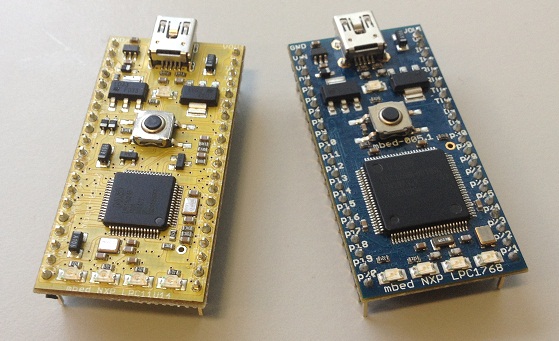
mbed NXP LPC11U24 (left) and mbed NXP LPC1768 (right)
The USB drag ānā drop programming interface works with Windows, Mac OS X and Linux, meaning you can re-flash the microcontroller without needing drivers or a programming application. The program binary can be easily generated using the mbed Online Compiler, or alternatively using any other standard offline toolchain like Keil uVision, Code Red, Code Sourcery, GCC, or IAR.
There is also support for a virtual serial port using the same USB interface, enabling communication with a PC terminal, Labview, Matlab, and any other programming language that can communicate with a COM port.
There's a typo in the above regarding the speed of the new M0 version - it still refers it to being 96MHz...
mbed NXP LPC11U24
The mbed NXP LPC11U24 is ideal for prototyping low-cost USB devices, battery powered applications and products that could take advantage of ARM Cortex-M0 based 32-bit MCUs.
This mbed Microcontroller board is based on the NXP LPC11U24 with a 32-bit ARM Cortex-M0 core running at 96MHz, 32KB FLASH, 8KB RAM and peripherals including USB Device, I2C, UART, SPI, ADC and other I/O interfaces.
Looking forward to playing with one of these very soon.
Cheers,
Jez
Hi guys,
There's a typo in the above regarding the speed of the new M0 version - it still refers it to being 96MHz...
mbed NXP LPC11U24
The mbed NXP LPC11U24 is ideal for prototyping low-cost USB devices, battery powered applications and products that could take advantage of ARM Cortex-M0 based 32-bit MCUs.
This mbed Microcontroller board is based on the NXP LPC11U24 with a 32-bit ARM Cortex-M0 core running at 96MHz, 32KB FLASH, 8KB RAM and peripherals including USB Device, I2C, UART, SPI, ADC and other I/O interfaces.
Looking forward to playing with one of these very soon.
Cheers,
Jez
<<quote ceri>>
is there an error above, the M0 now has 6 PWM's
<</quote>>
It is correct, the M0 now has 8 PWMs:
* CT16B0/MR0 on p5
* CT16B0/MR1 on p6
* CT16B0/MR2 on p34
* CT16B1/MR0 on p36
* CT16B1/MR1 on p20 and p14
* CT32B0/MR0 on p25
* CT32B0/MR1 on p26 and USBTX
* CT32B0/MR2 on p10
See: http://mbed.org/handbook/PwmOut
I've only had my mbed for a few days, however compared with the struggles from other .....devices it's a joy to use. Things work, and quickly. Course, now I just jinxed myself.
I know the LCP micro has two CAN ports, but on mbed there is only one implementation,
I thought this was supposed to list the mbed ready capabilities, or maybe there is a way of using the TWO CAN interfaces??
LPC-1768 CAN (2)?
I know the LCP micro has two CAN ports, but on mbed there is only one implementation,
I thought this was supposed to list the mbed ready capabilities, or maybe there is a way of using the TWO CAN interfaces??
Both CAN ports are available on the LPC-1768 mbed - per the handbook http://mbed.org/handbook/CAN
Pins 9/10 are one port, pins 30/29 are the other port.
Unfortunately the "official" pinout diagram (per the "credit card" picture you get with the mbed) only shows one port on p30/p29, and has not been updated to show the second port, so this question keeps coming up (as you can see in the comments on the handbook page).
Hi Ernesto,
Both CAN ports are available on the LPC-1768 mbed - per the handbook http://mbed.org/handbook/CAN
Pins 9/10 are one port, pins 30/29 are the other port.
Unfortunately the "official" pinout diagram (per the "credit card" picture you get with the mbed) only shows one port on p30/p29, and has not been updated to show the second port, so this question keeps coming up (as you can see in the comments on the handbook page).
Hello! Could somebody tell me which are the mbed corresponding pins for p1.19, p1.22, p1.25, p1.26, p1.28, p1.29 (which are the output pins for those 3 motor control PWM channels). If there aren't, could somebody give me a code example on how could these lpc1768 pins could be routed for the mbed dip pins. Thanks!
<<quote kartex30>>
Could somebody tell me which are the mbed corresponding pins for p1.19, p1.22, p1.25, p1.26, p1.28, p1.29
<</quote>>
These pins are not available on the lpc1768 mbed. Here is an overview of all lpc1768 pins on mbed:
http://mbed.org/users/Lerche/notebook/lpc1768-pin-functions/
Here is an overview of all lpc11U24 pins on mbed:
http://mbed.org/users/Lerche/notebook/lpc11u24-pin-functions/#c3047
I have created an image that shown the microcontroller port pin connected to each dip pin in LPC11U24
http://mbed.org/users/alexan_e/notebook/pinout-of-the-mbed-lpc11u24/
Alex
I own a NXP LPX1768 breakout board( I think thats it ). It a full blow 1768 board. I love to see for the first time something work on a microcontroller ,even if it is an led. I am curious if the code compole here will work on my other board. (which I am still trying to compile and upload a program.) My plans are to create the programs on the mbed and transfer to the main break out board just to see if I can do it. So it would be: on-line compiler > mbed > NXP LPC 1768 main board. Again, my main question: is the code built here usable on the main LPC 1768 board?
triad
I own a NXP LPX1768 breakout board( I think thats it ). It a full blow 1768 board. I love to see for the first time something work on a microcontroller ,even if it is an led. I am curious if the code compole here will work on my other board. (which I am still trying to compile and upload a program.) My plans are to create the programs on the mbed and transfer to the main break out board just to see if I can do it. So it would be: on-line compiler --> mbed --> NXP LPC 1768 main board. Again, my main question: is the code built here usable on the main LPC 1768 board?
triad
The concept is great! Everything just works right from scratch! Are the any other hardware variants planned? I'd like to see an LPC1768 board with the motor control pins available! (+CAN, SPI, I2C, AnalogIn, ...)
Please login to post comments.