RTOS
This content relates to a deprecated version of Mbed
Mbed 2 is now deprecated. For the latest version please see the Mbed OS documentation.
For the latest RTOS API, please see RTOS.
Import librarymbed-rtos
Official mbed Real Time Operating System based on the RTX implementation of the CMSIS-RTOS API open standard.
Last commit 04 Jul 2017 by  mbed official
Thread
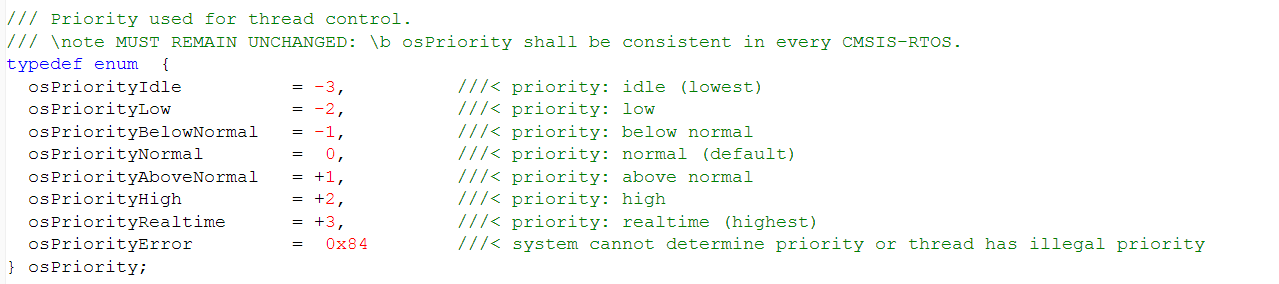
The Thread class allows defining, creating, and controlling thread functions in the system. The function main is a special thread function that is started at system initialization and has the initial priority osPriorityNormal.
Import program
00001 #include "mbed.h"
00002 #include "rtos.h"
00003
00004 DigitalOut led1(LED1);
00005 DigitalOut led2(LED2);
00006 Thread thread;
00007
00008 void led2_thread() {
00009     while (true) {
00010         led2 = !led2;
00011         Thread::wait(1000);
00012     }
00013 }
00014
00015 int main() {
00016     thread.start(led2_thread);
00017
00018     while (true) {
00019         led1 = !led1;
00020         Thread::wait(500);
00021     }
00022 }
main
The main function is already the first thread scheduled by the rtos.
Import library
Public Types |
|
| enum |
State
{
Inactive , Ready , Running , WaitingDelay , WaitingInterval , WaitingOr , WaitingAnd , WaitingSemaphore , WaitingMailbox , WaitingMutex , Deleted } |
|
State of the Thread . More... |
|
Public Member Functions |
|
| Thread (osPriority priority=osPriorityNormal, uint32_t stack_size=DEFAULT_STACK_SIZE, unsigned char *stack_pointer=NULL) | |
|
Allocate a new thread without starting execution.
|
|
| MBED_DEPRECATED_SINCE ("mbed-os-5.1"," Thread -spawning constructors hide errors. ""Replaced by thread.start(task).") Thread(mbed | |
|
Create a new thread, and start it executing the specified function.
|
|
| template<typename T > | |
| MBED_DEPRECATED_SINCE ("mbed-os-5.1"," Thread -spawning constructors hide errors. ""Replaced by thread.start(callback(task, argument)).") Thread(T *argument | |
|
Create a new thread, and start it executing the specified function.
|
|
| template<typename T , typename M > | |
| MBED_DEPRECATED_SINCE ("mbed-os-5.1","The start function does not support cv-qualifiers. ""Replaced by thread.start(callback(obj, method)).") osStatus start(T *obj | |
|
Starts a thread executing the specified function.
|
|
| osStatus | join () |
|
Wait for thread to terminate.
|
|
| osStatus | terminate () |
|
Terminate execution of a thread and remove it from Active Threads.
|
|
| osStatus | set_priority (osPriority priority) |
|
Set priority of an active thread.
|
|
| osPriority | get_priority () |
|
Get priority of an active thread.
|
|
| int32_t | signal_set (int32_t signals) |
|
Set the specified Signal Flags of an active thread.
|
|
| int32_t | signal_clr (int32_t signals) |
|
Clears the specified Signal Flags of an active thread.
|
|
| State | get_state () |
|
State of this
Thread
.
|
|
| uint32_t | stack_size () |
|
Get the total stack memory size for this
Thread
.
|
|
| uint32_t | free_stack () |
|
Get the currently unused stack memory for this
Thread
.
|
|
| uint32_t | used_stack () |
|
Get the currently used stack memory for this
Thread
.
|
|
| uint32_t | max_stack () |
|
Get the maximum stack memory usage to date for this
Thread
.
|
|
Static Public Member Functions |
|
| static osEvent | signal_wait (int32_t signals, uint32_t millisec=osWaitForever) |
|
Wait for one or more Signal Flags to become signaled for the current RUNNING thread.
|
|
| static osStatus | wait (uint32_t millisec) |
|
Wait for a specified time period in millisec:
|
|
| static osStatus | yield () |
|
Pass control to next thread that is in state READY.
|
|
| static osThreadId | gettid () |
|
Get the thread id of the current running thread.
|
|
| static void | attach_idle_hook (void(*fptr)(void)) |
|
Attach a function to be called by the RTOS idle task.
|
|
| static void | attach_terminate_hook (void(*fptr)(osThreadId id)) |
|
Attach a function to be called when a task is killed.
|
|
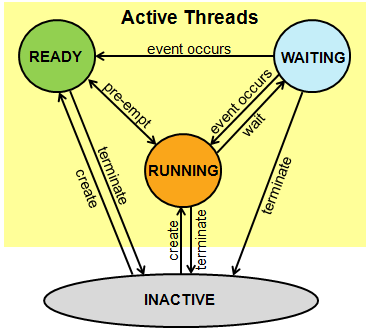
A Thread can be in the following states:
- RUNNING: The thread that is currently running is in the RUNNING state. Only one thread at a time can be in this state.
- READY: Threads which are ready to run are in the READY state. Once the RUNNING thread has terminated or is WAITING the next READY thread with the highest priority becomes the RUNNING thread.
- WAITING: Threads that are waiting for an event to occur are in the WAITING state.
- INACTIVE: Threads that are not created or terminated are in the INACTIVE state. These threads typically consume no system resources.
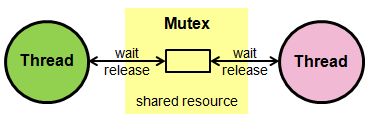
Mutex
A Mutex is used to synchronize the execution of threads: for example to protect the access to a shared resource.
ISR
The Mutex methods cannot be called from interrupt service routines (ISR).
Import program
00001 #include "mbed.h"
00002 #include "rtos.h"
00003
00004 Mutex stdio_mutex;
00005
00006 void notify(const char* name, int state) {
00007     stdio_mutex.lock();
00008     printf("%s: %d\n\r", name, state);
00009     stdio_mutex.unlock();
00010 }
00011
00012 void test_thread(void const *args) {
00013     while (true) {
00014         notify((const char*)args, 0); Thread::wait(1000);
00015         notify((const char*)args, 1); Thread::wait(1000);
00016     }
00017 }
00018
00019 int main() {
00020     Thread t2;
00021     Thread t3;
00022
00023     t2.start(callback(test_thread, (void *)"Th 2"));
00024     t3.start(callback(test_thread, (void *)"Th 3"));
00025
00026     test_thread((void *)"Th 1");
00027 }
C standard library mutexes
The ARM C standard library has already mutexes in place to protect the access to stdio, therefore on the M3 mbed the above example is not necessary. On the contrary, ARM microlib (used on the M0 mbed) does not provide default stdio mutexes making the above example a necessity.
stdio (printf, putc, getc, etc), malloc & new in ISR
Because of the mutexes in the ARM C standard library you cannot use stdio (printf, putc, getc, etc), malloc and new in ISR!
Import library
Public Member Functions |
|
| Mutex () | |
|
Create and Initialize a
Mutex
object.
|
|
| osStatus | lock (uint32_t millisec=osWaitForever) |
|
Wait until a
Mutex
becomes available.
|
|
| bool | trylock () |
|
Try to lock the mutex, and return immediately.
|
|
| osStatus | unlock () |
|
Unlock the mutex that has previously been locked by the same thread.
|
|
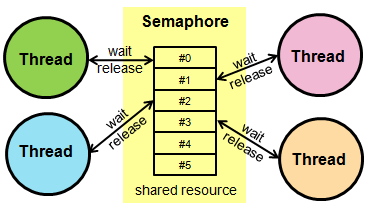
Semaphore
A Semaphore is particularly useful to manage thread access to a pool of shared resources of a certain type.
Import program
00001 #include "mbed.h"
00002 #include "rtos.h"
00003
00004 Semaphore two_slots(2);
00005
00006 void test_thread(void const *name) {
00007     while (true) {
00008         two_slots.wait();
00009         printf("%s\n\r", (const char*)name);
00010         Thread::wait(1000);
00011         two_slots.release();
00012     }
00013 }
00014
00015 int main (void) {
00016     Thread t2;
00017     Thread t3;
00018
00019     t2.start(callback(test_thread, (void *)"Th 2"));
00020     t3.start(callback(test_thread, (void *)"Th 3"));
00021
00022     test_thread((void *)"Th 1");
00023 }
Import library
Public Member Functions |
|
| Semaphore (int32_t count=0) | |
|
Create and Initialize a
Semaphore
object used for managing resources.
|
|
| int32_t | wait (uint32_t millisec=osWaitForever) |
|
Wait until a
Semaphore
resource becomes available.
|
|
| osStatus | release (void) |
|
Release a
Semaphore
resource that was obtain with Semaphore::wait.
|
|
Signals
Each Thread can be notified and wait for signals:
Import program
00001 #include "mbed.h"
00002 #include "rtos.h"
00003
00004 DigitalOut led(LED1);
00005
00006 void led_thread() {
00007     while (true) {
00008         // Signal flags that are reported as event are automatically cleared.
00009         Thread::signal_wait(0x1);
00010         led = !led;
00011     }
00012 }
00013
00014 int main (void) {
00015     Thread thread;
00016
00017     thread.start(callback(led_thread));
00018
00019     while (true) {
00020         Thread::wait(1000);
00021         thread.signal_set(0x1);
00022     }
00023 }
Queue
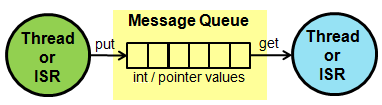
A Queue allows you to queue pointers to data from producers threads to consumers threads:
Queue<message_t, 16> queue;

message_t *message;

queue.put(message);

osEvent evt = queue.get();
if (evt.status == osEventMessage) {
    message_t *message = (message_t*)evt.value.p;
Import programrtos_queue
Basic example showing the Queue and MemoryPool API
Last commit 15 Feb 2017 by mbed official
MemoryPool
The MemoryPool class is used to define and manage fixed-size memory pools:
MemoryPool<message_t, 16> mpool;

message_t *message = mpool.alloc();

mpool.free(message);
Import program
00001 #include "mbed.h"
00002 #include "rtos.h"
00003
00004 typedef struct {
00005     float    voltage;   /* AD result of measured voltage */
00006     float    current;   /* AD result of measured current */
00007     uint32_t counter;   /* A counter value               */
00008 } message_t;
00009
00010 MemoryPool<message_t, 16> mpool;
00011 Queue<message_t, 16> queue;
00012
00013 /* Send Thread */
00014 void send_thread (void) {
00015     uint32_t i = 0;
00016     while (true) {
00017         i++; // fake data update
00018         message_t *message = mpool.alloc();
00019         message->voltage = (i * 0.1) * 33;
00020         message->current = (i * 0.1) * 11;
00021         message->counter = i;
00022         queue.put(message);
00023         Thread::wait(1000);
00024     }
00025 }
00026
00027 int main (void) {
00028     Thread thread;
00029     thread.start(callback(send_thread));
00030
00031     while (true) {
00032         osEvent evt = queue.get();
00033         if (evt.status == osEventMessage) {
00034             message_t *message = (message_t*)evt.value.p;
00035             printf("\nVoltage: %.2f V\n\r"   , message->voltage);
00036             printf("Current: %.2f A\n\r"     , message->current);
00037             printf("Number of cycles: %u\n\r", message->counter);
00038
00039             mpool.free(message);
00040         }
00041     }
00042 }
Import library
Public Member Functions |
|
| MemoryPool () | |
|
Create and Initialize a memory pool.
|
|
| T * | alloc (void) |
|
Allocate a memory block of type T from a memory pool.
|
|
| T * | calloc (void) |
|
Allocate a memory block of type T from a memory pool and set memory block to zero.
|
|
| osStatus | free (T *block) |
|
Return an allocated memory block back to a specific memory pool.
|
|
Mail
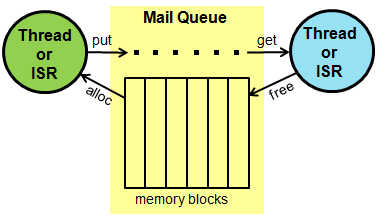
A Mail works like a queue with the added benefit of providing a memory pool for allocating messages (not only pointers).
Import program
00001 #include "mbed.h"
00002 #include "rtos.h"
00003
00004 /* Mail */
00005 typedef struct {
00006   float    voltage; /* AD result of measured voltage */
00007   float    current; /* AD result of measured current */
00008   uint32_t counter; /* A counter value               */
00009 } mail_t;
00010
00011 Mail<mail_t, 16> mail_box;
00012
00013 void send_thread (void) {
00014     uint32_t i = 0;
00015     while (true) {
00016         i++; // fake data update
00017         mail_t *mail = mail_box.alloc();
00018         mail->voltage = (i * 0.1) * 33;
00019         mail->current = (i * 0.1) * 11;
00020         mail->counter = i;
00021         mail_box.put(mail);
00022         Thread::wait(1000);
00023     }
00024 }
00025
00026 int main (void) {
00027     Thread thread;
00028     thread.start(callback(send_thread));
00029
00030     while (true) {
00031         osEvent evt = mail_box.get();
00032         if (evt.status == osEventMail) {
00033             mail_t *mail = (mail_t*)evt.value.p;
00034             printf("\nVoltage: %.2f V\n\r"   , mail->voltage);
00035             printf("Current: %.2f A\n\r"     , mail->current);
00036             printf("Number of cycles: %u\n\r", mail->counter);
00037
00038             mail_box.free(mail);
00039         }
00040     }
00041 }
Import library
Public Member Functions |
|
| Mail () | |
|
Create and Initialise
Mail
queue.
|
|
| T * | alloc (uint32_t millisec=0) |
|
Allocate a memory block of type T.
|
|
| T * | calloc (uint32_t millisec=0) |
|
Allocate a memory block of type T and set memory block to zero.
|
|
| osStatus | put (T *mptr) |
|
Put a mail in the queue.
|
|
| osEvent | get (uint32_t millisec=osWaitForever) |
|
Get a mail from a queue.
|
|
| osStatus | free (T *mptr) |
|
Free a memory block from a mail.
|
|
RTOS Timer
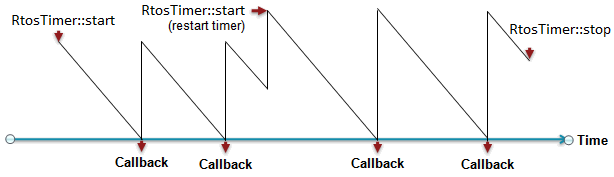
The RtosTimer class allows creating and and controlling of timer functions in the system. A timer function is called when a time period expires whereby both one-shot and periodic timers are possible. A timer can be started, restarted, or stopped. Timers are handled in the thread osTimerThread. Callback functions run under control of this thread and may use CMSIS-RTOS API calls.
Import program
00001 #include "mbed.h"
00002 #include "rtos.h"
00003
00004 DigitalOut LEDs[4] = {
00005     DigitalOut(LED1), DigitalOut(LED2), DigitalOut(LED3), DigitalOut(LED4)
00006 };
00007
00008 void blink(void const *n) {
00009     LEDs[(int)n] = !LEDs[(int)n];
00010 }
00011
00012 int main(void) {
00013     RtosTimer led_1_timer(blink, osTimerPeriodic, (void *)0);
00014     RtosTimer led_2_timer(blink, osTimerPeriodic, (void *)1);
00015     RtosTimer led_3_timer(blink, osTimerPeriodic, (void *)2);
00016     RtosTimer led_4_timer(blink, osTimerPeriodic, (void *)3);
00017
00018     led_1_timer.start(2000);
00019     led_2_timer.start(1000);
00020     led_3_timer.start(500);
00021     led_4_timer.start(250);
00022
00023     Thread::wait(osWaitForever);
00024 }
Import library
Public Member Functions |
|
| MBED_DEPRECATED_SINCE ("mbed-os-5.1","Replaced with RtosTimer (Callback<void()>, os_timer_type)") RtosTimer(void(*func)(void const *argument) | |
|
Create timer.
|
|
| osStatus | start (uint32_t millisec) |
|
Start the timer.
|
|
Interrupt Service Routines
The same RTOS API can be used in ISR. The only two warnings are:
Mutexcan not be used.- Wait in ISR is not allowed: all the timeouts in method parameters have to be set to 0 (no wait).
Import program
00001 #include "mbed.h"
00002 #include "rtos.h"
00003
00004 Queue<uint32_t, 5> queue;
00005
00006 DigitalOut myled(LED1);
00007
00008 void queue_isr() {
00009     queue.put((uint32_t*)2);
00010     myled = !myled;
00011 }
00012
00013 void queue_thread(void const *args) {
00014     while (true) {
00015         queue.put((uint32_t*)1);
00016         Thread::wait(1000);
00017     }
00018 }
00019
00020 int main (void) {
00021     Thread thread(queue_thread);
00022
00023     Ticker ticker;
00024     ticker.attach(queue_isr, 1.0);
00025
00026     while (true) {
00027         osEvent evt = queue.get();
00028         if (evt.status != osEventMessage) {
00029             printf("queue->get() returned %02x status\n\r", evt.status);
00030         } else {
00031             printf("queue->get() returned %d\n\r", evt.value.v);
00032         }
00033     }
00034 }
Default Timeouts
The mbed rtos API has made the choice of defaulting to 0 timeout (no wait) for the producer methods, and osWaitForever (infinitive wait) for the consumer methods.
A typical scenario for a producer could be a peripheral triggering an interrupt to notify an event: in the corresponding interrupt service routine you cannot wait (this would deadlock the entire system). On the other side, the consumer could be a background thread waiting for events: in this case the desired default behaviour is not using CPU cycles until this event is produced, hence the osWaitForever.
No wait in ISR
When calling an rtos object method in an ISR all the timeout parameters have to be set to 0 (no wait): waiting in ISR is not allowed.
Status and Error Codes
The Status and Error Codes section lists all the return values that the CMSIS-RTOS functions will return:
osOK: function completed; no event occurred.osEventSignal: function completed; signal event occurred.osEventMessage: function completed; message event occurred.osEventMail: function completed; mail event occurred.osEventTimeout: function completed; timeout occurred.osErrorParameter: parameter error: a mandatory parameter was missing or specified an incorrect object.osErrorResource: resource not available: a specified resource was not available.osErrorTimeoutResource: resource not available within given time: a specified resource was not available within the timeout period.osErrorISR: not allowed in ISR context: the function cannot be called from interrupt service routines.osErrorISRRecursive: function called multiple times from ISR with same object.osErrorPriority: system cannot determine priority or thread has illegal priority.osErrorNoMemory: system is out of memory: it was impossible to allocate or reserve memory for the operation.osErrorValue: value of a parameter is out of range.osErrorOS: unspecified RTOS error: run-time error but no other error message fits.
osEvent
The osEvent data structure is returned by get methods of Queue and Mail objects.
This data structure contains both an error code and a pointer to the actual data:
[Repository '/users/mbed_official/code/rtx/docs/tip/structosEvent.html' not found]
Implementation
The mbed RTOS is based on the CMSIS RTOS.