Recent changes
Order
tag order
RTOS
Help
mbed NXP LPC1768
Firmware
Homepage
From the mbed microcontroller Handbook.  

m0 release

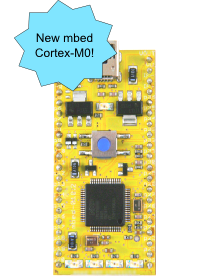
http://mbed.org/media/uploads/dan/m0-more3.png

Information

The first batch of mbed NXP LPC11U24 have now been released!

See mbed NXP LPC11U24

The new mbed NXP LPC11U24 Microcontroller is designed for prototyping USB devices, battery powered applications, and 32-bit ARM Cortex-M0 designs and it is almost ready for launch!

Beta Tester Projects

In order to ensure the M0 mbed is ready for final release we asked developers that we’re interested in testing the M0 mbed with us, to submit a project description that they thought might best utilize the new features of the new mbed.

The feedback from the beta testers has been invaluable and with their help we have ironed out a few minor bugs – so a big thanks for all of your support!

Here are some of the projects that the beta testers have been working on –

Fast logic analyser using Cortex-m0 mbed – Romily Cockling

Prototyping a logic analyser to measure a digital stream using the USB HID class

Flight Simulator Instrument - Michiel B.

The creation of an airplane instrumentation display for a flight simulator making use of the USBSerial class.

Joystick as USB Mouse - Adam Green

Using an mbed-M0 and thumb joystick to emulate a PC mouse showcasing the USBMouse library

RGB LED Strip Controller - Bertrand Achard

Developing a controller for a strip of individually addressable LEDs.

Example: USB Device Interfaces

This is going to be great for building USB devices. In the following video you can see how to emulate a USB mouse.

You can programatically send movement, button clicks and states, and even scroll the scroll wheel, and of course do this dependant on any sensors or logic you like. A really neat feature is the absolute version of the mouse, meaning you can move to a location on the screen; great for direct interaction with program interfaces.

Another example is USB Keyboard:

In this example, we're sending media keys to control the PC media player, but you could of course type strings or send interesting keycode combinations and sequences. A raw USBHID interface is also available to allow driverless custom interfaces to your favourite USB-capable programming language on the PC. We also have some other interfaces on the way, including USB MIDI (Musical Instrument Digital Interface) and USB Virtual Serial.

Example: Use in Battery Applications

This board should be good for prototyping battery applications. Here is an example of it being sent to sleep, woken up by a button to increment and update a screen, then going back to sleep:

It is running from a couple of AA's, and takes a couple of mA when not doing anything. The code is using some new sleep() and deepsleep() functions of the mbed C/C++ SDK. The code for this example uses deepsleep(), and looks like:

Simple deepsleep and interrupt wakeup example

#include "mbed.h"
#include "TextLCD.h"

TextLCD lcd(p21, p23, p24, p25, p26, p27);
InterruptIn wakeup(p14);

int i = 0;

void count() {
    lcd.locate (0,1);
    lcd.printf("%d",i);
    i++;
    wait(0.5);
}

int main () {
    wakeup.rise(NULL);  // Setup rising edge interrupt (no handler function needed)

    lcd.printf("Hello World!");

    while (1) {
        deepsleep();  // Deep sleep until external interrupt
        count();      // We've come out of sleep due to interrupt, so count!
    }
}

For both sleep() and deepsleep(), all state is retained so you can see it is a nice simple programming model. Should be great for quickly prototyping some things that need to run off batteries.


calendar Page history
Last modified 17 Jan 2012, by   user Simon Ford   tag No tags | 34 comments  

34 comments on m0 release:

26 Oct 2011

I hope the M3 mbed isnt going away :)

26 Oct 2011

So, differences from LPC1768 so far:

  1. less memory (128->32KB flash, 64KB->8KB RAM)
  2. slower (96->48MHz), no Thumb-2 instructions
  3. one I2C (instead of 2) and one serial (instead of 3)
  4. no AnalogOut
  5. no Ethernet or CAN
  6. no USB Host
  7. better power management (?)
  8. no eye-piercing blue led (hopefully?)

All in all, a somewhat substantial downgrade in features and performance, but could be a great deal for the right price.

BTW, the board seems to say LPC11U14?

26 Oct 2011

Hi Igor,

This is a photo of the beta board; the chip doesn't actually match the screen print ;) The joys of doing designs before silicon is confirmed!

You are spot on; this is definitely a board focused on prototyping low-cost devices with 32-bit performance. The power aspects are great, and I'm especially excited about the USB device; this chip is cheaper than even an FTDI chip, and you get an MCU thrown in! Hopefully should enable all sorts of products and applications.

And don't worry, it is not replacing the mbed NXP LPC1768. That will continue to be a great choice for many prototyping applications.

Hope you like it,

Simon

26 Oct 2011

Thats great.

26 Oct 2011

Cool. Now I can use a mbed in my battery powered alarm clock project.

27 Oct 2011

This is great for low power systems but is there also a faster mbed in the making ? (dual core 1GHz or so?)

27 Oct 2011

what would be the price of M0?

28 Oct 2011

I like the low power consumption! But I too vote for a faster mbed! Would be great to have some high speed rapid prototyping device!

29 Oct 2011

faster than 100Mhz ? how fast ? 600 or 1000 Mhz ? then you need a device capable of running Android , with external RAM , LCD controller etc This device could not probably fit in a breadboard and it is much more complicated to program , definetely ,not an entry level microcontroller and not the mbed target group ! I think the new small mbed could and should be a PIC killer ! (32 bit power at <1$ cost )

29 Oct 2011

Why you think that PIC is the low energy MCU, there are TI and Energy Micro in the arena with perfect result comparing to NXP. It is just the mbed which is bind to NXP and probably NXP try to promote their product through mbed, but this not mean that these is the best option which you can make. For low energy option you must use EFM32, I am impressed with their solution. Even for the current flow through GPIO you can setup the options with 0.5mA to 20mA per pin, plus their many unique futures where in Sleep mode many Low energy peripherals may operate. Personally I like mbed for it fast prototyping, it easy USB to Serial option, Ethernet, but for productions is not the best option. Ofcause it is depend of new mbed price as well if is less than 5 pounds then maybe is interesting point for think. But there many negative facts to this new mbed Cortex-M0, it has just one UART and only 32KB Flash this is past for new application, they should have at least 128KB of Flash and 16KB SRAM it will be also good.

Regards, Stas

29 Oct 2011

@Stas I was refering to killing price , not low energy . I cannot comment on a product's energy , that I have not read its datasheet , yet , but I expect its price to be in the <1 $ range . As you say , mbed is fast prototyping ... ( the fastest I've seen ! ) You can start in mbed CortexM0 and then export to Keil and program and debug a larger uc ( one of the larger LPC M0s ) , if one UART is not enough for you . Think of it , as Simon says ... , this chip is cheaper than even an FTDI chip, and you get an MCU thrown in!

29 Oct 2011

But it is shame to have one UART in nowadays MCU and so small Flash size and RAM. Also what I have not to seen here in mbed is the support of RAMFUNC option, where some function may run from RAM, for example interrupts, which will increase the speed of run. mbed team should think of it and also it should include option for setting in compiler and loader. But the thing is that the Keil for RAMFUNC use seperate file comparing to GCC or IAR where just some declaration need to be done for RAMFUNC.

Regards, Stas

29 Oct 2011

user X M wrote:

faster than 100Mhz ? how fast ? 600 or 1000 Mhz ? then you need a device capable of running Android , with external RAM , LCD controller etc This device could not probably fit in a breadboard and it is much more complicated to program , definetely ,not an entry level microcontroller and not the mbed target group ! I think the new small mbed could and should be a PIC killer ! (32 bit power at <1$ cost )

A lot of cell phones and low cost pad computers use ARM chips, even dual cores running at > 1GHz so size and power can not be the issue..

31 Oct 2011

Any chance we could get i datasheet of the chip? Need it for a custom PCB :D

31 Oct 2011

user Christian Lerche wrote:

Any chance we could get i datasheet of the chip? Need it for a custom PCB :D

If you have access to the (still unannounced) chips I expect you should be able to get the datasheets as well...

01 Nov 2011

Now we only need a LPC11C14/24 mbed or at least the compiler undersantding the ROM API rutines so we can change the chip.

01 Nov 2011

Me too John... but... While I hope I get this new mbed, I will design a PCB for your peripherals such as PCB Orange ...

01 Nov 2011

user Gert van der Knokke wrote:

user X M wrote:

faster than 100Mhz ? how fast ? 600 or 1000 Mhz ? then you need a device capable of running Android , with external RAM , LCD controller etc This device could not probably fit in a breadboard and it is much more complicated to program , definetely ,not an entry level microcontroller and not the mbed target group ! I think the new small mbed could and should be a PIC killer ! (32 bit power at <1$ cost )

A lot of cell phones and low cost pad computers use ARM chips, even dual cores running at > 1GHz so size and power can not be the issue..

Gert have you seen this new TI platform it has onboard 3D graphic accelerator, 256MB, USB, ethernet, many peripherals, it open source and cost 89$ which 56 pounds or 65 euro http://www.eetimes.com/electronics-products/electronic-product-reviews/processors/4230221/BeagleBoard-adds--89-board-with-Sitara-AM335x?cid=NL_MCU&Ecosystem=microcontroller-mcu I think this new beast is nice tool for advanced application! :) It based on ARM Cortex-A8 and run up to 720MHz, wow! :) It seems TI come to put new platform in some way similar as mbed but much more advanced, and I think they come in the right time.

02 Nov 2011

No PWM?

05 Nov 2011

No PWM and no analog out. oh dear :P

05 Nov 2011

Hi L, Igor,

It does actually have some versatile timer blocks, so it will be possible to have at least a couple of full hardware pwm channels. There is of course scope for software PWM on all the other pins, dependant on the requirements of the application. We'll take a look to supporting the hardware timers for PWM...

Simon

05 Nov 2011

Simon,

Software PWM would be nice, especially for keeping pinout the same as the mbed m3 (if hardware PWM does not allow for that.)

I imagine most people use PWM for servos and such so software PWM would be sufficient if done seamlessly by the mbed library.

05 Nov 2011

We now have 4 new pins, So a DAC, could be bit based out on them, Liner technology has a wonderfull selection.

Regards

Ceri

10 Nov 2011

I second that.
I would like to see either a DAC or better some PWM Channels on it
(how to communicate with the analog world instead ?)

[EDIT] found out that there is "real" PWM on the "LPC11U24" - that's good.

BTW: I can not find a "LPC11U24" on the NXP Homepage (?)
http://www.nxp.com/products/microcontrollers/cortex_m0/lpc11u00/#products

11 Nov 2011

user John Herrmann wrote:

Now we only need a LPC11C14/24 mbed or at least the compiler undersantding the ROM API rutines so we can change the chip.

Is that true or a joke ? ;-)
Would it be really possible to change the chip to an LPC11C24 ?
(to have CAN)

13 Nov 2011

user Igor Martinovski wrote:

No PWM and no analog out. oh dear :P

My Uniserv library uses interrupts to generate a PWM signal on any digital I/O pin, I assume it would work on this new board.

24 Nov 2011

When it goes on sale?

03 Dec 2011

What about a VID/PID combo for this board? Would you guys provide a PID on demand for a low production quantity like FTDI and Microchip do?

03 Dec 2011

Question, if we don't buy this new product, can we still compile code for it using the online IDE?

03 Dec 2011

Hi Maurice,

Take a look at this from the recent NXP LPC11U24 press release:

Quote:

To reduce time to market and overall costs, NXP is taking an important step by offering customers the option to sub-license the company’s USB Vendor ID number, eliminating a significant start-up cost for USB product developers. With the LPC11U2x, NXP will also offer USB Implementers Forum (USB-IF) certification, giving users the assurance that their designs comply with the USB specification and are interoperable with existing USB solutions.

Sounds like what you were after :)

btw, it looks like all is in order, so expect to see this new board to be turning up in distributors in about two to three weeks time! Will announce actual release date on the m0 release mailing list when it is confirmed.

Simon

03 Dec 2011

Hi Frank,

When you buy an mbed Microcontroller kit, it includes the microcontroller hardware, a usb lead and a license to use the online tools for that type of board. So yes, to use the tools for the LPC11U24, you'd need to buy an mbed NXP LPC11U24.

I know it is a bit of a dated model, but we think charging some money in return for building the hardware and all the efforts we put in to building the tools is a good one :P Hopefully you'll think it is great value too, and support us by going out and buying one!

Simon

09 Dec 2011

user Andreev Alexander wrote:

When it goes on sale?

We have stock on sale right now!

http://www.coolcomponents.co.uk/catalog/product_info.php?products_id=858

30 Dec 2011
12 Feb 2012

I NEED EAGLE LIBRARY FOR LPC11U24. I LOOKED AT THE PDF VERSION AND IT HAS IC6 LPC11U1X. BUT I CANT FIND *.LBR FILE ANY WHERE I DONT WANT TO WASTE MY TIME TO MAKE A LIBRARY ON EAGLE BECOUSE I M NOT THAT GOOD AT EAGLE AND I MAKE EASYLY LOTS OF MISTAKES.

Please login to post comments.