PortOut
This content relates to a deprecated version of Mbed
Mbed 2 is now deprecated. For the latest version please see the Mbed OS documentation.
For the latest PortOut API, please see PortOut.
The PortOut interface is used to write to an underlying GPIO port as one value. This is much faster than BusOut as you can write a port in one go, but much less flexible as you are constrained by the port and bit layout of the underlying GPIO ports.
A mask can be supplied so only certain bits of a port are used, allowing other bits to be used for other interfaces.
Hello World!
Import program
00001 // Toggle all four LEDs
00002
00003 #include "mbed.h"
00004
00005 // LED1 = P1.18  LED2 = P1.20  LED3 = P1.21  LED4 = P1.23
00006 #define LED_MASK 0x00B40000
00007
00008 PortOut ledport(Port1, LED_MASK);
00009
00010 int main() {
00011     while(1) {
00012         ledport = LED_MASK;
00013         wait(1);
00014         ledport = 0;
00015         wait(1);
00016     }
00017 }
API
Import librarymbed
No documentation found.
Interface
The PortOut Interface can use any pins with a blue label, as long as they are in the same GPIO port.
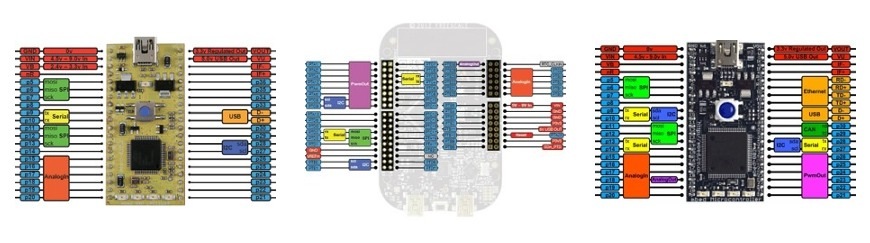 |
| See the Pinout page for more details |